We’re Going Back
Tonight, at 6:24 p.m. Eastern, four people are going to climb into a capsule on top of a 322-foot rocket at Kennedy Space Center and leave the Earth.

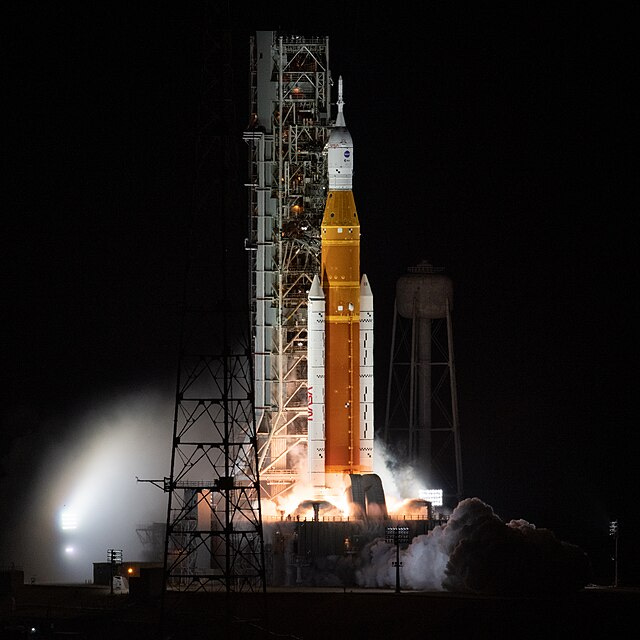
(image: the Artemis I in 2022)
hey’ll travel to the Moon, loop around the far side, and — if everything goes as planned — splash down in the Pacific Ocean nine days from now. The mission is called Artemis II, and it is the first time since December of 1972 that any human being has traveled beyond low Earth orbit.
It has been fifty-three years since anyone has made that trip. And before we talk about what’s happening tonight, it’s worth remembering what the first era of lunar exploration actually looked like. Not the mythology of it — the reality of it.
What We Did Before
In December of 1968, the world was coming apart. Martin Luther King Jr. had been assassinated in April. Bobby Kennedy in June. The Tet Offensive was reshaping public opinion about Vietnam. There were race riots in American cities and violent clashes at the Democratic National Convention. And into that year — on Christmas Eve — three astronauts aboard Apollo 8 orbited the Moon and read the opening verses of Genesis on live television. A billion people watched. One in four human beings on the planet, listening to the same words at the same time. After splashdown, a telegram arrived for the crew. It said: “Thank you Apollo 8. You saved 1968.”
Seven months later, Apollo 11 landed on the Moon. And that landing very nearly didn’t happen. During the descent, the onboard computer triggered five alarms in forty seconds — it was overloaded with data. A twenty-six-year-old engineer in Mission Control named Jack Garman had to make a call, right then, whether to abort or continue. He said go. Armstrong then had to manually fly past the planned landing site, which turned out to be a boulder field, to find clear ground. When Eagle finally touched down, they had somewhere around fifteen seconds of fuel remaining. Armstrong’s heart rate — the man was famously unflappable — was at 150. Six hundred million people watched the landing live. Ninety-three percent of American television households tuned in.
Then there was Apollo 13, in April of 1970. An oxygen tank exploded two hundred thousand miles from Earth. The crew never reached the surface. But on their free-return trajectory around the far side of the Moon, they reached the farthest point from Earth any human being has ever been — 248,655 miles. That record has stood for fifty-six years. Tonight’s crew will break it.
And then the program ended. On December 14, 1972, Gene Cernan climbed the ladder of the lunar module for the last time. Before he did, he said something worth hearing in full:
> “As I take man’s last step from the surface, back home for some time to come — but we believe not too long into the future — I’d like to just say what I believe history will record: that America’s challenge of today has forged man’s destiny of tomorrow. And, as we leave the Moon at Taurus-Littrow, we leave as we came and, God willing, as we shall return, with peace and hope for all mankind.”
“Not too long into the future” turned out to be fifty-four years. Cernan died in January of 2017 without seeing anyone go back. The Saturn V production line was shut down. Apollo missions 18, 19, and 20 were all cancelled. NASA pivoted to the Space Shuttle, which flew 135 missions over thirty years and never once left low Earth orbit. We built the International Space Station — genuinely one of the great engineering achievements in human history — but it orbits at about 250 miles altitude. The Moon is a thousand times farther away.
What Changed
The physics of getting to the Moon didn’t change. The engineering didn’t become impossible. We just stopped prioritizing it. For fifty years, there were other things to fund and other arguments to have.
What made tonight possible isn’t a single breakthrough. It’s a series of institutional decisions, made over the last fifteen years, that going to the Moon again was worth doing. The program was proposed, cancelled, restructured, renamed, delayed, and delayed again. It survived three presidential administrations, two rocket redesigns, and a pandemic. They named it Artemis — Apollo’s twin sister in Greek mythology — and whatever you think of the symbolism, it tells you something about how the people building this thing see it. This is the continuation of something that started in the 1960s and got interrupted for half a century.
Who’s Going
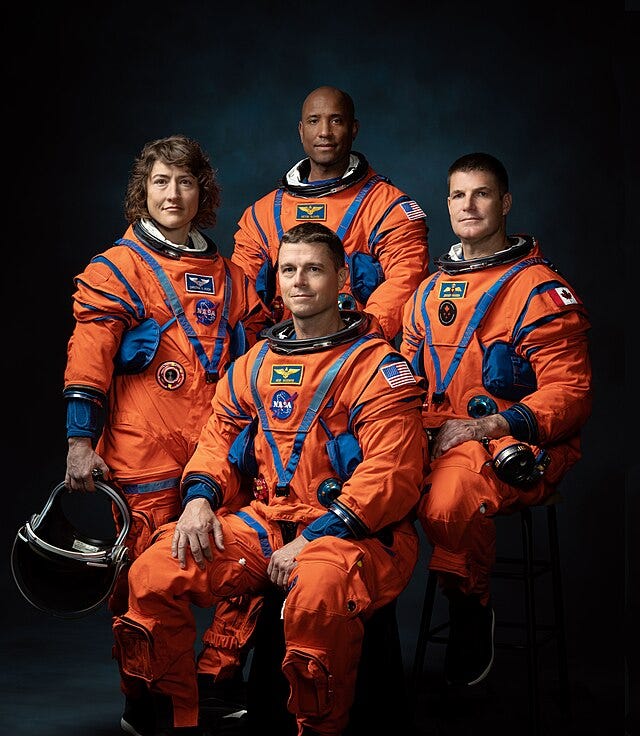
The crew is worth knowing about. Reid Wiseman commands the mission — Navy test pilot, former Space Station commander. Victor Glover pilots the Orion capsule and will be the first Black astronaut to fly to the Moon. Christina Koch, who already holds the record for the longest single spaceflight by a woman, will be the first woman on a lunar mission. And Jeremy Hansen, a Canadian fighter pilot, will become the first non-American to travel beyond low Earth orbit.
During the Apollo program, every person who flew to the Moon was a white American man. That wasn’t because of some shortage of ability in the rest of the population. This crew looks different, and the fact that it looks different matters, even if you don’t think much about symbolism.
What Happens Tonight — and After
They are not landing on the Moon tonight. This is a flyby — a test of the Orion spacecraft, the life support, the navigation, the communications, the abort systems. The crew will swing around the far side, pass within about 4,100 miles of the surface, and come home. It’s the kind of mission that doesn’t make for great movie trailers but makes every mission after it possible.
The first landing since Cernan’s comes with Artemis IV, currently targeted for early 2028. That mission goes to the Moon’s south pole, where permanently shadowed craters hold water ice — potentially extractable for drinking water, oxygen, and rocket fuel. And the plan extends well beyond a single landing.
Last month, NASA announced it was redirecting twenty billion dollars away from a planned orbital station around the Moon and toward something considerably more ambitious: a permanent base on the surface. The plan unfolds in three phases stretching into the mid-2030s — habitable structures, power systems, rovers, a communications network, eventually something like a lunar GPS constellation. Two crewed landing missions per year once it’s fully operational. Sixty-one countries have signed the Artemis Accords. SpaceX and Blue Origin are each building competing landers under contract.
The difference between Apollo and Artemis, if the plan holds, is the difference between a visit and a permanent presence. Everything being tested and built for the Moon — the life support, the resource extraction, the construction techniques — is being designed with the understanding that the same technology will eventually need to work somewhere farther away. No one has announced a date for a crewed Mars mission, and no timeline for that should be taken seriously yet. But the architecture is pointing in that direction, deliberately, and a direction sustained over enough time is how large things actually get built.
Why This Matters
We talk a lot at Grant Town about the difference between optimism as a feeling and optimism as a discipline. Optimism as a feeling is what you get from watching a launch montage with swelling music. It’s real, and it fades fast.
Optimism as a discipline is what it takes to spend fifteen years building a rocket that might scrub on launch day, and then show up the next morning to try again. It’s sixty-one nations negotiating an agreement about how to conduct themselves on a world none of them have reached yet. That kind of optimism isn’t glamorous. But it’s the kind that produces things.
Tonight
The launch window opens at 6:24 p.m. EDT. NASA is broadcasting live. The weather is 80% favorable.
There won’t be a bootprint tonight. No one plants a flag or delivers a speech on the surface. Four people leave the Earth, travel farther from home than any human being has since 1972, and do the work that proves we can go back.
Gene Cernan said we’d return. It took fifty-four years. He didn’t live to see it.
But tonight, we go.